





WASHINGTON, DC — The U.S. Supreme Court declined Monday to hear a challenge to Maine's 72-hour firearm waiting period, leaving in place an appeals court decision that removed a preliminary injunction against the law. The October 19 order in Beckwith v. Frey does not decide whether Maine's restriction complies with the Second Amendment.
The petition, docketed as No. 26-258, appears among the cases denied review in the Court's order list. No explanation or dissent accompanies the entry.
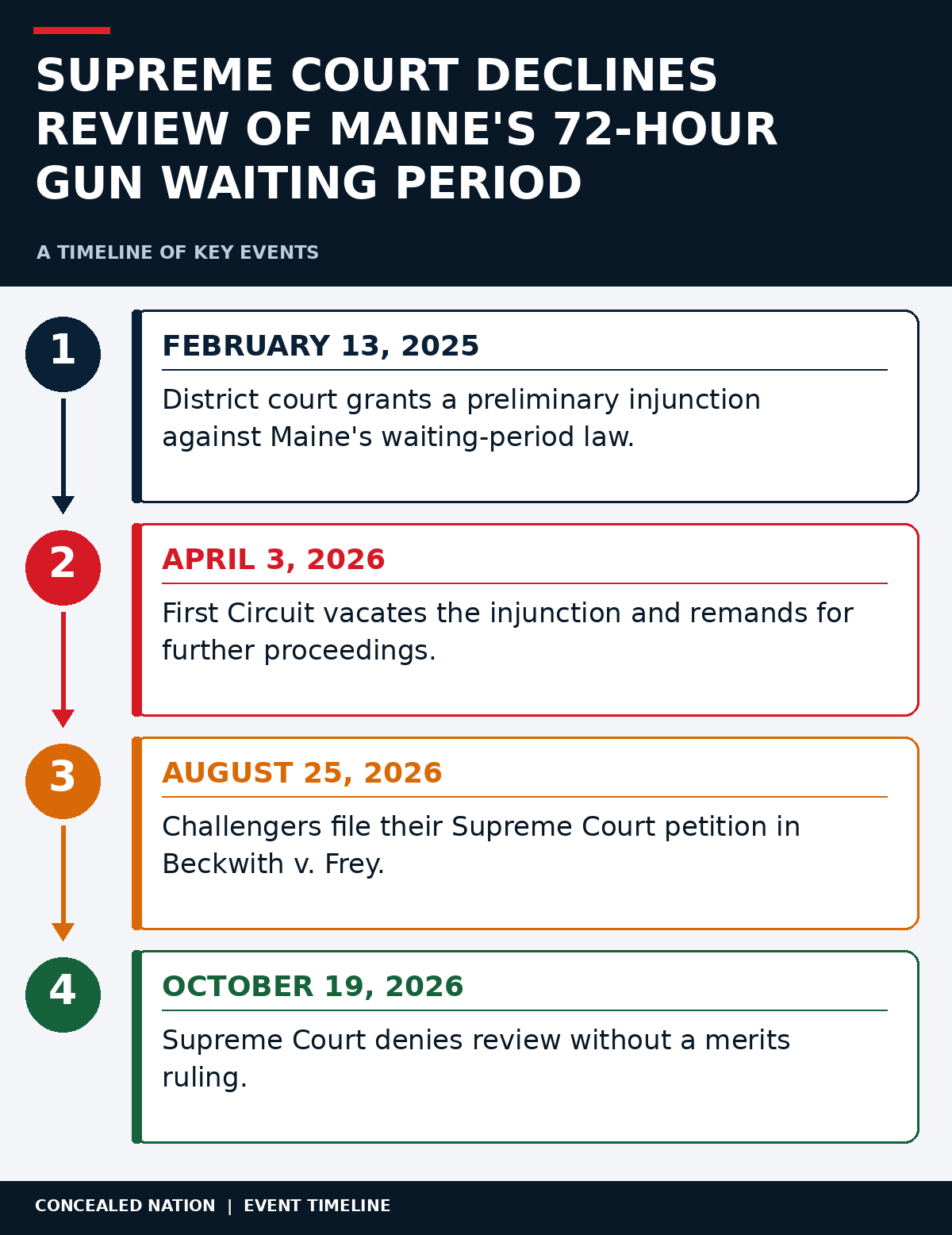
Firearms instructor Andrea Beckwith, East Coast School of Safety, individual purchasers and firearms businesses sought review of an April 3 First Circuit decision. That court vacated the injunction and sent the case back for further proceedings, concluding that the challengers were unlikely to prevail on their claim that the law was unconstitutional on its face.
The disagreement centers on how the constitutional right to keep and bear arms applies to acquiring a firearm. The First Circuit reasoned that Maine's rule regulates when a purchased firearm can be delivered rather than directly restricting possession or carrying. It treated the delay as a condition on commercial sales and rejected the request to block enforcement at that stage.
The challengers argued in their August 25 petition that a buyer who has already passed a background check should not have to wait several more days before taking possession. They asked the justices to address whether that cooling-off requirement violates the Second Amendment.
Under Maine's current statute, a seller generally cannot knowingly deliver a firearm sooner than 72 hours after the purchase agreement. That clock runs alongside any waiting period associated with a required background check, rather than automatically being added after it.
The statute contains exceptions, including specified family transactions, sales to dealers and certain other transactions. The Court's refusal to take this appeal neither expands those exceptions nor establishes a nationwide rule for waiting periods.
For now, the practical result is that the First Circuit's decision on temporary relief remains undisturbed. The Supreme Court has not endorsed its reasoning or issued a merits ruling resolving the constitutional dispute.
Timeline
Legal and safety breakdown
What the order changes
| Question | Effect |
|---|---|
| Will the Supreme Court hear this petition? | No. The October 19 order denies review in No. 26-258. |
| Did the justices uphold the law on its merits? | No. Declining review leaves the lower-court result undisturbed without adopting its reasoning. |
| How does the statutory clock work? | Maine Title 25, section 2016 generally measures 72 hours from the agreement and runs that time concurrently with a required background-check waiting period. |
The First Circuit reviewed a preliminary injunction, not a final trial judgment. Its opinion vacated that temporary relief and remanded the case. Those procedural limits matter when describing what the Supreme Court declined to review.
Safety Tip: If facing a credible threat, contact emergency services and make a safety plan that does not depend on completing a firearm purchase immediately. Keep any lawfully owned firearm secured against unauthorized access.