





GRAY, TN — A man who fatally shot a 24-year-old during an August confrontation in Gray will not face criminal charges, Tennessee prosecutors announced October 13, saying he acted in self-defense after being knocked to the ground and losing his prosthetic leg.
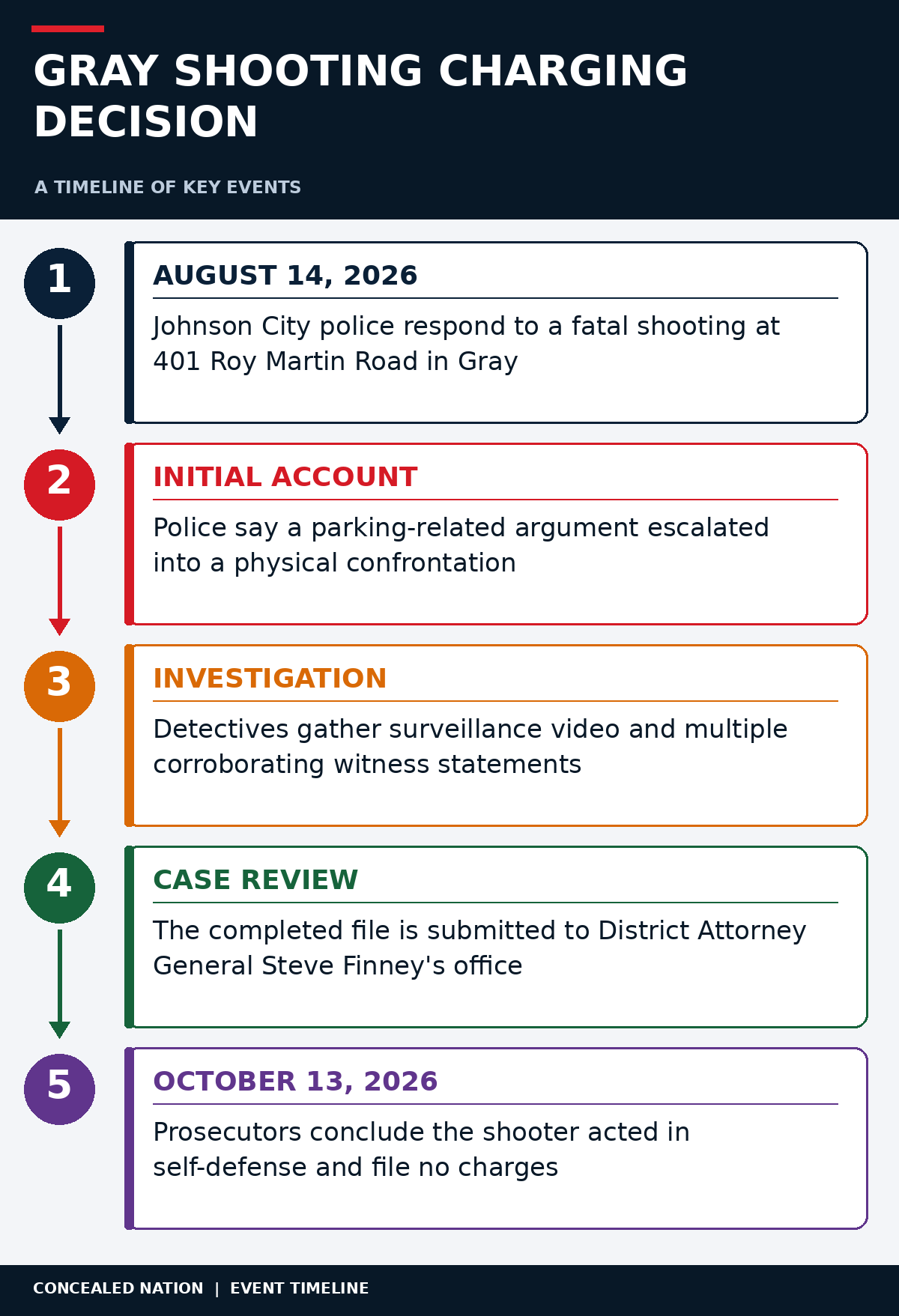
District Attorney General Steve Finney’s office said surveillance video and witness statements supported its finding that Dalton Spaulding was the aggressor. The decision followed a Johnson City Police Department investigation into the August 14 shooting outside a business at 401 Roy Martin Road.
According to the district attorney’s account, reported by WJHL, Spaulding accused the other man of looking disrespectfully at his grandfather, who was waiting in the parking lot. Spaulding then threw the man to the ground, causing his prosthetic leg to detach, prosecutors said.
The assault continued while the man was on the ground, Finney’s office said. The man fired four rounds from a .38-caliber revolver, striking Spaulding three times in the chest and arm. Officers who responded found Spaulding dead at the scene.
Police initially described a dispute connected to a parking space that escalated into a physical confrontation. The prosecutor’s later account provided more detail about the alleged assault and the circumstances leading to the gunfire.
Finney’s office said multiple witnesses corroborated the account and that surveillance footage showed the entire encounter. After reviewing the completed investigative file, prosecutors concluded that criminal charges were not warranted.
The reports did not identify the man who fired the shots.
Timeline
Legal and safety breakdown
Tennessee Code Section 39-11-611(b)(2) sets conditions for using deadly force without a duty to retreat. A person must be somewhere they have a right to be, must not be engaged in conduct constituting a felony or Class A misdemeanor, and must reasonably believe they face imminent death, serious bodily injury or grave sexual abuse. The perceived danger must be real or honestly believed to be real, and the belief must rest on reasonable grounds.
The statute also limits a self-defense claim by someone who provokes the other person’s unlawful force. An exception can apply when that person abandons the encounter or clearly communicates an intent to do so, but the other person continues.
In this case, prosecutors cited the assault, the man’s position on the ground and the supporting video and witness accounts in explaining their self-defense finding. Their announcement resolves the criminal charging decision; it is not a civil judgment.
Safety Tip: If a verbal dispute begins escalating, create distance early, avoid arguing over perceived disrespect, call 911 when safe, and preserve video or witness information for investigators. After any defensive-force incident, summon medical help and do not disturb evidence.