





BUFFALO, NY — A federal judge in Buffalo ruled Wednesday that New York’s restrictions on purchasing and selling body armor violate the Second Amendment, granting summary judgment to two residents and the Firearms Policy Coalition in Heeter v. James.
U.S. District Judge John L. Sinatra Jr. concluded in a 47-page decision filed October 21 that body armor falls within the constitutional meaning of “arms.” He permanently enjoined enforcement of New York General Business Law Section 396-eee and Penal Law Sections 270.21 and 270.22 as they apply to the purchase and sale of body armor.
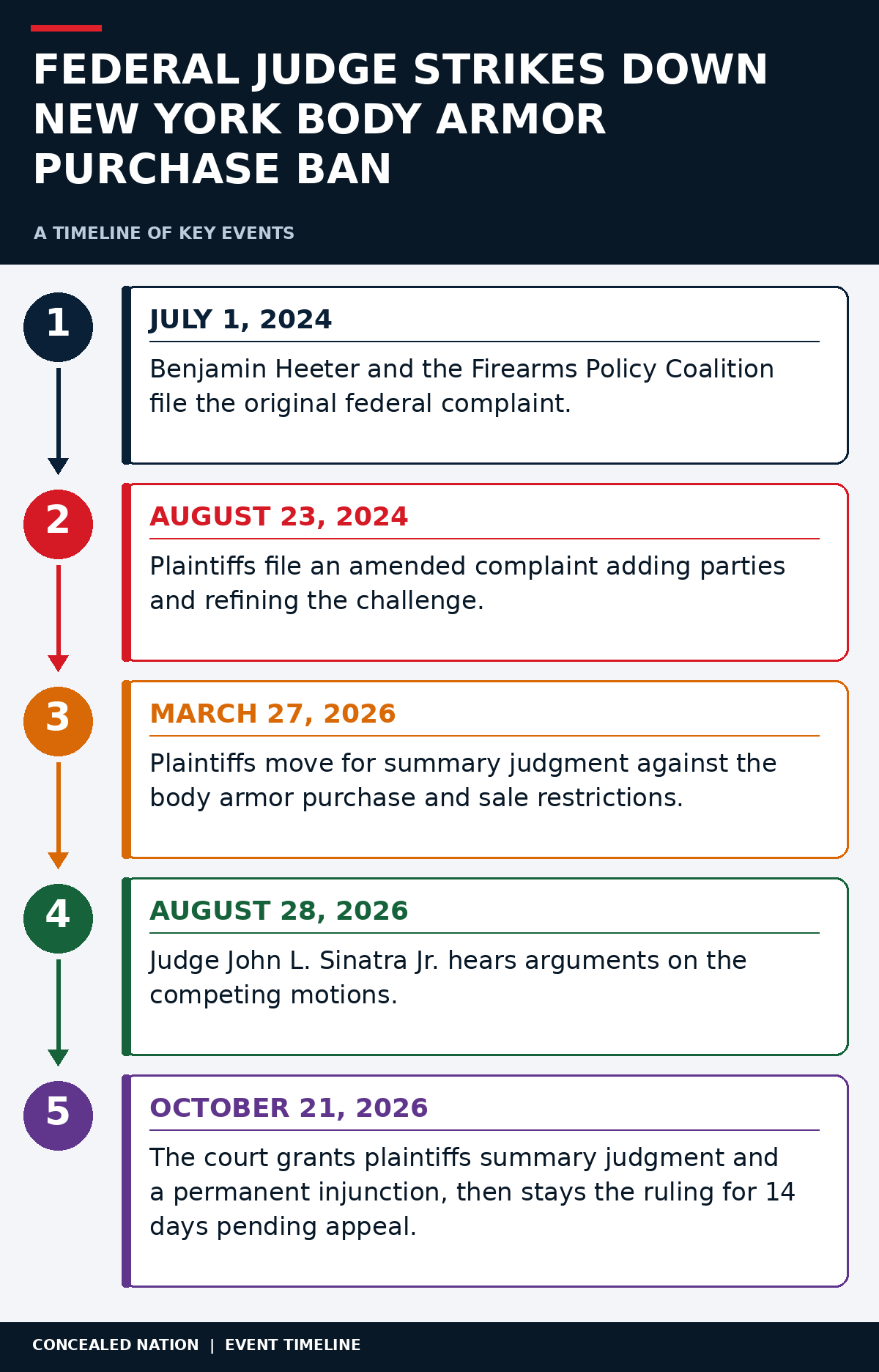
The decision does not create an immediate practical change. Sinatra granted the state’s request for a 14-day stay pending appeal, giving New York time to seek further relief from an appellate court. The state has not yet completed any appeal, and the ruling could be reviewed or stayed again.
New York generally limits body armor purchases to people working in professions the state considers eligible. Plaintiffs Benjamin Heeter and Joseph Wurtenberg said they wanted to acquire body armor for lawful protection but refrained because of the criminal and civil consequences attached to the state restrictions.
The state argued that body armor was not an arm within the Second Amendment’s text and that historical laws supported restrictions on armor. Sinatra rejected both arguments. He found that the ordinary historical meaning of arms included defensive armor and that the state had not supplied a well-established historical analogue for a broad civilian purchase ban.
The ruling concerns the purchase and sale provisions challenged in this lawsuit. It does not disturb New York Penal Law Section 270.20, which separately prohibits wearing body armor while committing certain violent felonies with a firearm, rifle or shotgun.
Because the district court granted a permanent injunction after summary judgment, the next major question is whether New York appeals and whether the Second Circuit extends the current stay. Until the stay expires or an appellate court acts, residents and sellers should not assume that the challenged restrictions have ceased to operate.
Timeline
Legal and safety breakdown
What the ruling changes
| Issue | Court’s treatment |
|---|---|
| Purchase and sale restrictions | Enjoined under the Second Amendment |
| Definition of body armor | Treated as a protected defensive arm |
| Historical justification | State did not establish a sufficiently analogous tradition |
| Wearing armor during a violent felony | Separate Penal Law Section 270.20 remains unaffected |
| Immediate effect | District court granted a 14-day stay pending appeal |
The decision applies the text-and-history method used in modern Second Amendment cases. Once the court held that body armor falls within the Amendment’s text, New York had to justify its restriction through a historical tradition of comparable regulation. The court found the cited laws too different in purpose and operation.
This is a district court judgment, not a final nationwide rule. An appeal could change the legal analysis or the scope and timing of relief. The 14-day stay is especially important because it temporarily suspends the injunction while the state considers appellate options.
Safety Tip: Do not treat a newly issued court ruling as immediate permission to ignore an existing restriction. Check the order, any stay and later appellate filings before purchasing or transferring regulated equipment.