





BOSTON, MA — Massachusetts' highest court upheld the state's age-21 requirement for a license to carry a firearm, rejecting a facial Second Amendment challenge and affirming the conviction of a man who was 20 when police recovered a handgun he discarded while fleeing a traffic stop.
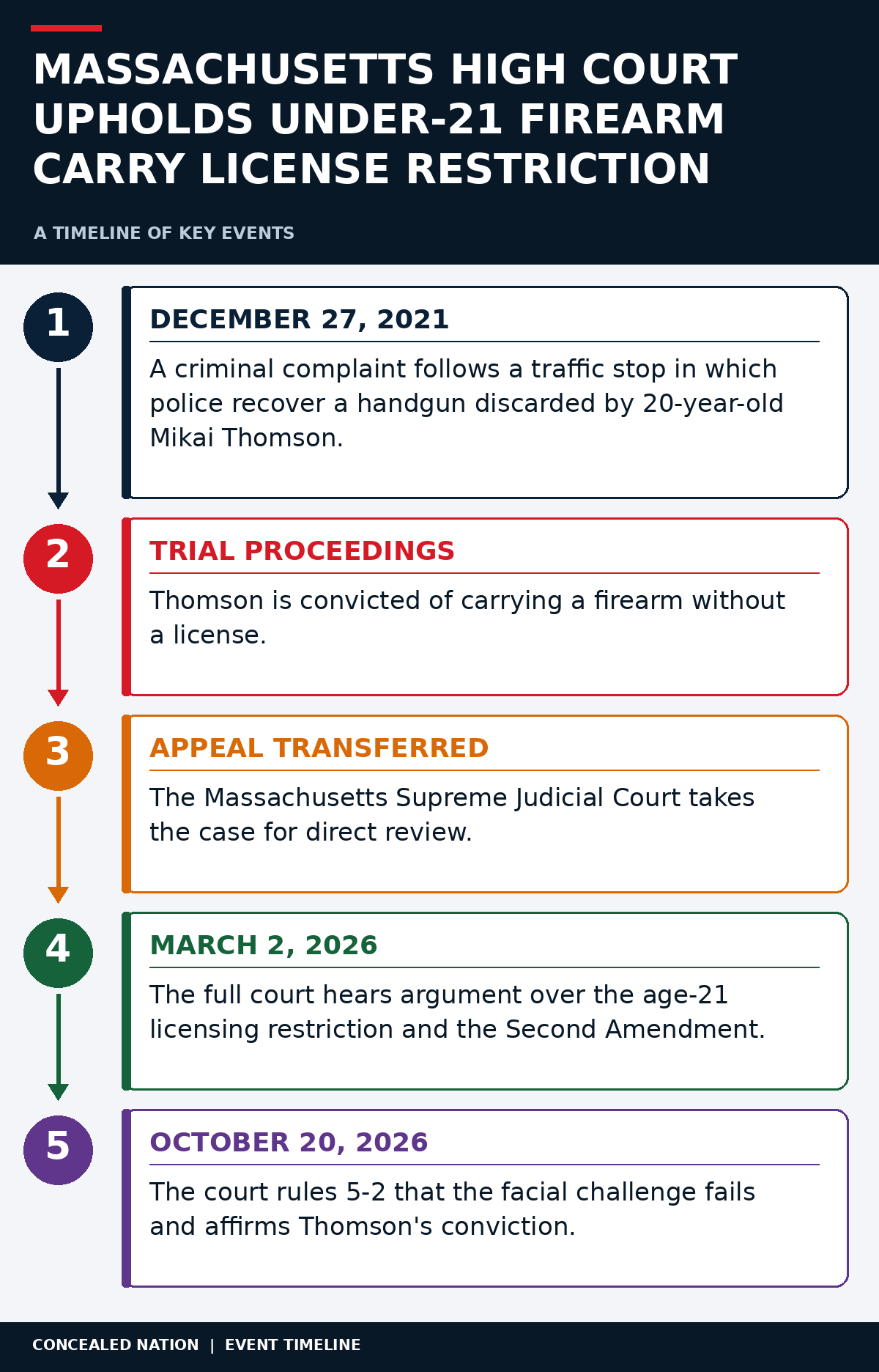
The Supreme Judicial Court issued its 5-2 decision in Commonwealth v. Thomson on October 20. Justice Gabrielle Wolohojian wrote that restricting firearm possession by people deemed too young to handle guns safely outside supervised settings is consistent with the nation's regulatory tradition.
Mikai Thomson was a passenger in a car stopped after a red-light violation in December 2021. According to the court, he ran from police and discarded a semiautomatic handgun. He was convicted of carrying a firearm without a license and challenged Massachusetts General Laws Chapter 140, Section 131, which does not permit people under 21 to obtain a license to carry.
The majority assumed without deciding that a person under 21 belongs to "the people" protected by the Second Amendment. It then compared the modern licensing rule with historical militia and youth-possession practices, concluding that both tied younger people's access to firearms to age, supervision and setting.
The court allowed Thomson to raise a facial challenge, meaning he could argue that the age restriction is unconstitutional in all its applications. It found he lacked standing to pursue an as-applied challenge because he had never applied for or been denied a license.
Two justices dissented from the historical analysis. They would have returned the case to a lower court for a more developed evidentiary record with expert testimony rather than resolving the tradition question on the existing submissions and the court's own research.
The ruling controls Massachusetts state courts but does not resolve continuing disagreement among federal courts over firearm rights for adults ages 18 to 20. Further review could be sought, and other age-based cases may produce different results under federal appellate precedent.
Timeline
Legal and safety breakdown
How the court analyzed the challenge
| Question | Majority conclusion |
|---|---|
| Does handgun carry implicate the Second Amendment? | Yes |
| Are people under 21 part of "the people"? | Assumed without deciding |
| Did Thomson have an as-applied claim? | No, because he never applied for a license |
| Could he raise a facial challenge? | Yes |
| Is the age-21 rule historically supported? | Yes, under the majority's analogy to supervised youth possession |
| Result | Conviction affirmed |
The majority treated founding-era militia rules and laws governing minors as relevant analogues because they linked youth firearm access to responsible adult supervision and limited settings. The dissent did not simply declare the age rule unconstitutional. It argued that the historical record needed fuller development before the court could decide the question.
The ruling concerns Massachusetts' license-to-carry age restriction and Thomson's conviction. It should not be read as a nationwide resolution of firearm rights for all 18-to-20-year-olds because other jurisdictions and federal circuits have analyzed similar laws differently.
Safety Tip: Age, residency and license requirements vary sharply by state and can change through litigation. Verify current rules with the issuing authority before carrying or transporting a handgun.