





The Brief:
Florida has implemented the final phase of its 2026 school safety legislation, establishing a 1,000-foot perimeter around educational facilities. Discharging a firearm within this zone is now a second-degree felony carrying up to 15 years in prison. The law includes exemptions for self-defense and private property owners.
Additionally, the legislation expands the campus guardian program, permitting trained public college and university staff to carry concealed firearms on campus. While supporters argue this reduces emergency response times, some student groups believe state legislators should focus on violence prevention rather than introducing more firearms.
TALLAHASSEE, FL — More than a year of legislative negotiations culminated this week as Florida finalized the enforcement framework for its sweeping 2026 school safety package. While core components regarding threat assessments, training, and mental health resources were implemented earlier in July, the final statutory piece governing physical boundaries around educational facilities is now active law.
The central pillar of this final phase focuses directly on the exterior perimeter of educational institutions, targeting violent street crime and reckless firearm discharges occurring just outside school boundaries.
The 1,000-Foot Zone and Increased Criminal Penalties
State Representative Michelle Salzman, who spearheaded the legislative push, pointed out that recent violent encounters near educational centers often had zero relation to academic activities, yet placed children directly in danger.
“The shootings were not related to the schools, but they had no boundaries,” Representative Salzman explained. “They didn’t care that it was across the street, and they were just shooting at people. Kids could have been walking home from school. They could have been on the playground and caught a stray bullet.”
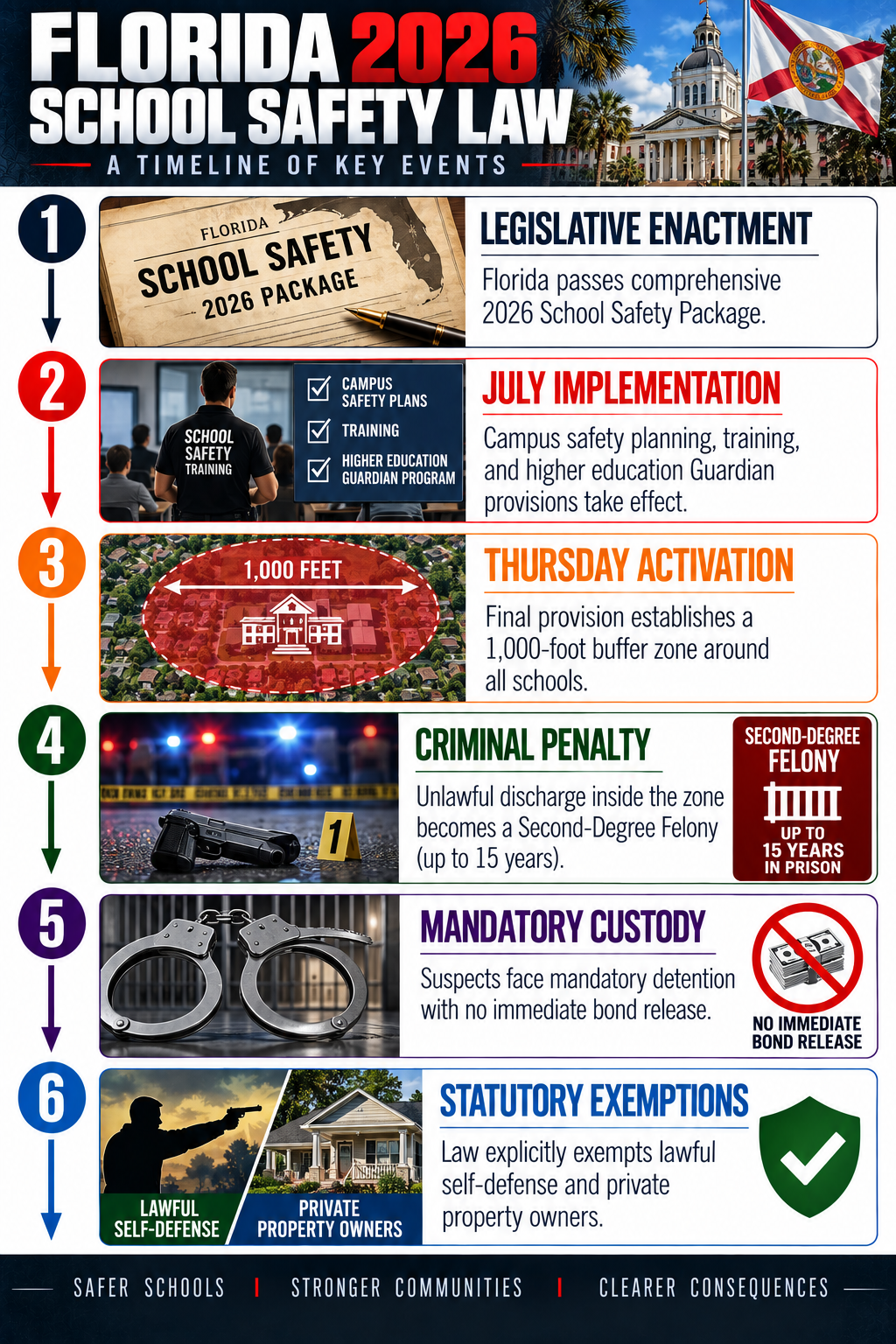
Under the new statutory framework:
- Second-Degree Felony: Discharging a firearm or weapon on school property or within 1,000 feet of an educational facility is categorized as a second-degree felony, punishable by up to 15 years in state prison.
- Mandatory Custody Hold: Anyone arrested under the firearm discharge provision cannot receive immediate release or station-house bail; defendants must remain in physical custody until appearing before a judge for formal bond determination.
- Critical Legal Exemptions: The statute specifically protects citizens exercising lawful self-defense, as well as private property owners lawfully discharging firearms on their own private land situated within the 1,000-foot radius.
Law enforcement leaders across the state voiced support for the expanded statutory authority.
“The message is simple. If you bring a gun on campus or near campus, the Hillsborough County Sheriff’s Office will hold you accountable,” said Brittany Muller, Public Affairs Bureau Manager for the Hillsborough County Sheriff’s Office.
Campus Guardian Expansion Sparks Debate
The broader legislation also addresses security on higher education grounds. Building upon the Coach Aaron Feis Guardian Program created after the 2018 Parkland tragedy, the 2026 law allows Florida public colleges and universities to implement policies permitting designated faculty and staff to carry concealed firearms on campus after undergoing extensive vetting and tactical training.
The expansion has sparked discussion among student groups at major institutions, including Florida State University.
“I think it says a lot that our state legislator is willing to offshore campus safety to us, when at the end of the day, it is their responsibility to make us safe,” said Andres Cubillos, an FSU graduate student who argued that campus resources should center on violence prevention rather than adding firearms to academic spaces.
Supporters counter that vetted, trained on-site staff dramatically compress response times during critical incidents, ensuring that educators possess the tools required to protect innocent life before off-campus patrol units arrive.
Tactical & Legal Context: Navigating School Zones for Lawful Gun Owners
For lawful concealed carriers and homeowners residing in suburban communities, statutory buffer zones demand careful situational awareness.
- Clear Recognition of Self-Defense: By writing an express carve-out for lawful self-defense directly into the statute, Florida lawmakers ensured that a citizen who uses a defensive tool to stop a violent crime on a public street or sidewalk within 1,000 feet of a school cannot be charged under this enhanced discharge felony.
- Preserving Private Property Rights: The explicit exemption for private property owners prevents the law from infringing upon homeowners whose residences happen to sit within a block or two of a school fence line.
- Awareness of Transit Routes: Lawful carriers traveling near school zones must remain mindful of state and federal definitions regarding campus grounds, particularly when picking up or dropping off passengers during peak school transit hours.
Safety Tip: GPS applications and vehicle navigation systems rarely flag 1,000-foot perimeters around primary or secondary schools. When traveling through dense residential or commercial neighborhoods adjacent to school properties, maintain strict situational awareness regarding school zone flashing beacons and crosswalks. If a critical encounter occurs where defensive force becomes unavoidable near these corridors, contact 911 immediately, establish your status as the victim or reporting party, and clearly state the defensive nature of the encounter to arriving investigators.